How Early Can You Use the Ramzi Theory?
Stop waiting 20 weeks in agonizing suspense. Learn exactly how early you can safely and accurately predict your baby's gender using your first ultrasound.
📌 Key Takeaways
- The Ramzi Method can be used starting at exactly 5 weeks gestation.
- The optimal "sweet spot" for visual clarity is between 6 and 8 weeks.
- You can still receive a highly accurate prediction up to 11+ weeks.
- You do not have to wait for the standard 20-week anatomy scan.
- The method works by mapping the location of the early placenta.
- Our AI software is authorized to read scans from 5 to 11+ weeks.
🧩 The First Trimester Timeline
🏥 The 20-Week Myth
If you ask a traditional doctor when you will find out if you are having a boy or a girl, the answer is almost always the same: "We will check at your 20-week anatomy scan." For expecting mothers, waiting half of an entire pregnancy just to find out the gender feels like an eternity. It delays the bonding process, stalls nursery planning, and fuels massive anxiety.
This agonizing wait is precisely why so many mothers begin searching for early ultrasound gender determination techniques. You want answers now, not in four months. The good news is that medical science has advanced significantly, and you do not have to wait for your baby's physical anatomy to develop to know the gender.
⏱️ The 5-Week Threshold
So, exactly how early can you use the Ramzi Theory? The biological baseline is 5 weeks gestation. At 5 weeks, your doctor will typically perform an early dating scan to confirm the pregnancy and ensure the gestational sac is safely located inside the uterus.
While the baby itself looks like nothing more than a tiny speck at this stage, the biological process that the Ramzi Method relies on is already fully underway. As we explain in our core guide on what is the Ramzi theory, male and female embryos immediately begin anchoring themselves to specific sides of the uterine wall. At 5 weeks, the chorionic villi (the tissue that will eventually grow into the mature placenta) has established its lateral location. If our AI can map this location on the right or left, it can predict the gender.
The Ultimate 6-Week Validation
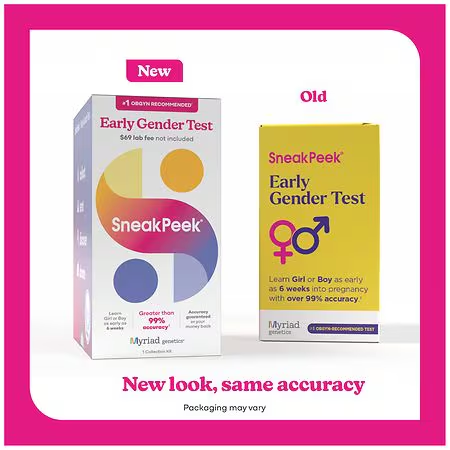
Because the Ramzi Method can be used at 5 weeks, you get your visual answer incredibly early. Many moms love the confidence of a "double confirmation." At 6 weeks, you become eligible for our partners at SneakPeek, who offer a highly accurate clinical at-home DNA blood test. Use Ramzi for instant gratification at 5 weeks, and follow up with DNA at 6 weeks for ultimate peace of mind.
Explore SneakPeek DNA Tests ➔🎯 6 to 8 Weeks: The Visual Sweet Spot
While 5 weeks is the earliest possible threshold, the visual "sweet spot" for applying the Ramzi Method is generally between 6 and 8 weeks. During this window, the echogenic borders of the uterus are significantly more defined on the sonogram monitor.
Additionally, 6 to 8 weeks is when a fetal heartbeat is usually detected. This provides a clearer, high-contrast image of the fetal pole relative to the chorionic tissue, making it much easier for our AI to establish the sagittal plane and determine lateralization. This clarity is a major factor in how accurate is the Ramzi theory when evaluated clinically.
⏳ Up to 11+ Weeks: Still in the Window
A common misconception is that if you miss the 8-week mark, you have missed your chance. This is incorrect. Expecting mothers can still submit their ultrasound scans for a Ramzi prediction all the way up to 11+ weeks gestation.
While the baby begins to grow rapidly during weeks 9, 10, and 11, the original implantation site of the chorionic villi can still be isolated by advanced imaging software. It is only when approaching the 12th to 14th weeks that the mature placenta begins to occupy too much space, making it difficult to pinpoint the exact original lateralization. If you are in your late first trimester, you are still well within the window for an early reveal!
🤖 Why AI Outperforms Human Eyes Early On
The main reason traditional doctors refuse to predict gender at 5 or 6 weeks is that human eyes are simply not equipped to accurately map a blurry, microscopic tissue formation while adjusting for the complex "mirror effect" created by ultrasound wands.
Our proprietary Artificial Intelligence was built specifically to overcome this human limitation. It does not matter if your scan is 5 weeks or 11+ weeks; the AI instantly corrects the spatial orientation of the image and utilizes complex algorithmic mapping to locate the placenta. It averages a highly accurate 97.2% clinical precision rate, providing you with a definitive, early answer long before your doctor’s 20-week appointment.
Frequently Asked Questions
Can I use a 4-week ultrasound for the Ramzi Method?
Generally, no. At 4 weeks gestation, the gestational sac is often too small, and the chorionic villi have not firmly established a visible lateral location in the uterine wall. 5 weeks is the absolute earliest benchmark for accurate placental mapping.
Is an 8-week scan too late for the Ramzi Theory?
No, an 8-week ultrasound is actually an excellent time to use the Ramzi Method. The echogenic borders are very clear. In fact, our AI software is highly capable of analyzing scans all the way up to 11+ weeks before the uterus becomes too crowded and the mature placenta obscures the original implantation site.
Can I use the Ramzi Method before taking a SneakPeek test?
Yes! Because the Ramzi Method relies on visual sonogram mapping starting at 5 weeks, you can receive your AI gender prediction before you are even eligible to take the 6-week SneakPeek maternal blood draw. Many mothers use Ramzi first for instant peace of mind.
Are You Ready to Meet Your Baby?
Skip the manual guesswork. Upload your 5 to 11+ week ultrasound today and receive your instant AI Ramzi analysis and celebration video in seconds.
Submit Your Scan ➔